
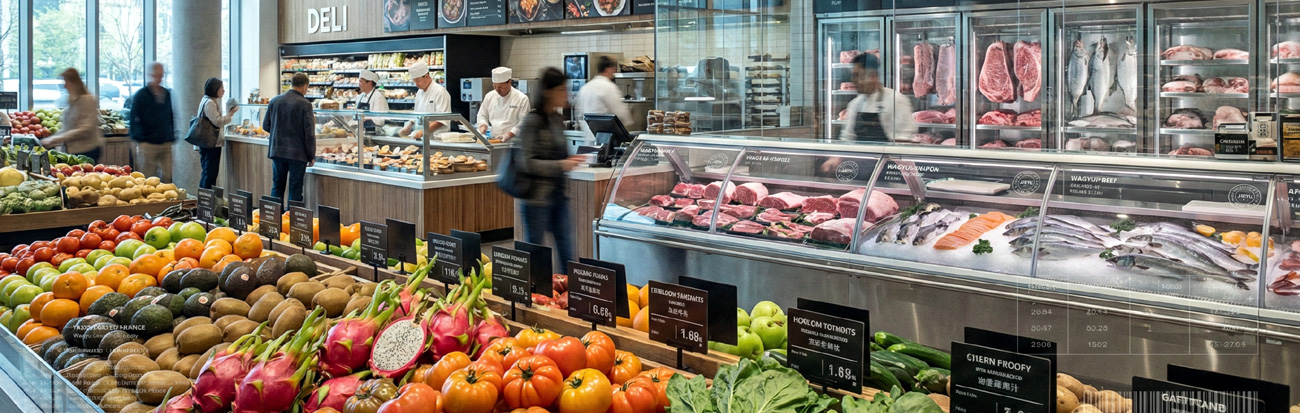
You’ve probably heard industry professionals talk about frozen food, produce, or meat categories. These familiar groupings represent just one way to organize food products, but here’s the reality: the food industry doesn’t use a single classification system. Multiple frameworks operate simultaneously, and they often don’t align with each other.
This isn’t a problem that needs fixing. No universal classification system exists because different parts of the industry need to answer different questions. These parallel systems don’t conflict by accident—they’re intentionally designed to serve specific purposes across commerce, regulation, and operations.
In this article we review all of the various food category systems. Each classification framework addresses distinct strategic needs. Understanding how food categories work means recognizing that these systems are purpose-built tools, each engineered to solve particular challenges in the complex landscape of modern food production, distribution, and retail. The following systems are more granular than how a typical supermarket is designed.
Global Regulatory & Food Safety Systems
What they optimize for: Public health, legal compliance, international alignment
Codex Alimentarius — Food Category System
Overview
A global regulatory framework that classifies foods to determine which additives are permitted and at what levels. It uses a hierarchical structure of approximately 16 top-level food categories.
Who uses it
Governments, regulators, multinational manufacturers, and international trade bodies.
Things to know
-
- Built for additive regulation, not consumer understanding
- The closest thing to a global food reference—within regulatory scope only
IFSAC Food Categorization Scheme
Overview
A risk-based classification system created specifically for foodborne illness surveillance and outbreak investigations.
Who uses it
CDC, FDA, USDA, and epidemiologists.
Things to know
-
- Broad categories are intentional
- Optimized for tracing pathogens, not describing products
FDA Food Code
Overview
A model code regulating retail and foodservice operations, focused on food handling, storage, and preparation.
Who uses it
State and local health departments; restaurants and grocery stores.
Things to know
-
- Applies to foodservice and retail, not manufacturing
- Regulates how food is handled, not what the food is
Commercial & Market Intelligence Systems
What they optimize for: Sales measurement, pricing, merchandising
Retail Scanner Data Taxonomies
Overview
UPC-based, proprietary product groupings used to measure market share, sales velocity, and pricing trends.
Who uses it
CPG manufacturers, retailers, investors, and market research firms.
Things to know
-
- Definitions vary by provider
- Designed for analytics, not nutrition or regulation
Supermarket Perimeter vs. Center Store Convention
Overview
An operational retail framework separating fresh, labor-intensive departments from shelf-stable aisles.
Who uses it
Retail operators, merchandisers, store planners.
Things to know
-
- Reflects store economics, not food science
- A convention, not a formal classification system
Logistics & Global Trade Systems
What they optimize for: Customs enforcement, legal clarity, system interoperability
Harmonized System (HS) Codes
Overview
A legally binding, six-digit international code defining goods for tariffs, quotas, and trade controls.
Who uses it
Customs authorities, exporters, importers, trade professionals.
Things to know
-
- Legal definitions override common language
- Misclassification has financial consequences
GS1 Global Product Classification (GPC)
Overview
A standardized, machine-readable hierarchy ensuring food products are identified consistently across global supply chains.
Who uses it
Manufacturers, retailers, logistics providers, and enterprise systems.
Things to know
-
- Built for computers first, humans second
- Enables interoperability across platforms
Scientific & Processing-Based Classification Systems
What they optimize for: Health research and dietary outcomes
NOVA Classification
Overview
Groups foods into four categories based on degree of industrial processing, independent of nutrients.
Who uses it
Public health researchers and policymakers.
Things to know
-
- Often conflicts with commercial classifications
- Highly influential and controversial
SIGA Classification
Overview
An extension of processing-based logic that evaluates foods using additives and industrial markers.
Who uses it
Nutrition researchers and health-focused platforms.
Things to know
-
- More granular than NOVA
- Still emerging, not globally standardized
What We Eat in America (WWEIA)
Overview
A detailed dietary intake classification used to connect what people eat with health outcomes.
Who uses it
USDA, nutrition scientists, epidemiologists.
Things to know
-
- Extremely granular
- Designed for population-level analysis
Economic & Industrial Classification Systems
What they optimize for: Economic measurement and policy
NAICS
Overview
A system that classifies business establishments, not foods, by primary economic activity.
Who uses it
Governments, economists, tax authorities, investors.
Things to know
-
- Answers “what does the company do?”
- Not a food taxonomy
Digital Product Passports (Emerging)
Overview
A forthcoming framework attaching environmental and lifecycle data to products sold in regulated markets.
Who uses it
Regulators, manufacturers, and supply-chain auditors.
Things to know
-
- Metadata overlay, not a food classification system
- Complements existing taxonomies rather than replacing them