
Our Top 10 U.S. Grocers page often sparks debate—especially around why Walmart ranks first overall, while Kroger is considered the largest U.S. supermarket. The confusion usually comes down to definitions. Walmart, Costco, and Target all sell groceries at enormous scale, but technically they are not supermarkets. They operate under different retail formats, even though grocery is a major part of their business.
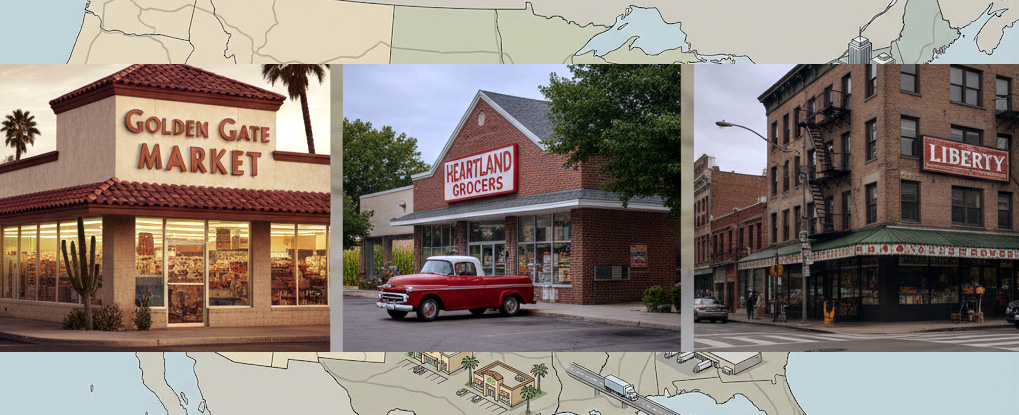
That distinction matters because the supermarket industry developed long before today’s retail formats began to blur. For decades, supermarkets dominated food retail, and they were overwhelmingly regional businesses. That regional structure wasn’t accidental. It emerged from practical, on-the-ground realities that shaped how grocery companies could operate efficiently.
Historically, supermarkets organized themselves regionally for several key reasons:
- Local preferences: Product assortments had to reflect regional tastes, cultural differences, and seasonal availability.
- Distribution networks: Regional supply chains reduced transportation costs and allowed for fresher, more reliable delivery.
- Competitive landscape: Grocers competed primarily with nearby chains, making local market knowledge a major advantage.
- Regulatory factors: Food, labor, and alcohol regulations varied widely by state and municipality.
- Real estate costs: Site selection, store size, and operating economics differed dramatically from one region to another.
Over time, retail formats expanded and converged. Supermarkets added services, mass merchants pushed deeper into food, and specialty and warehouse models scaled nationally. Even so, today’s grocery market still operates as a complex, regionally structured system shaped by distribution infrastructure, banner portfolios, and localized merchandising strategies. Regional supermarket operators remain central players across the U.S.
Our ‘Major U.S. Supermarket Companies by Region’ list below breaks out the major supermarket companies across six core U.S. regions. We use this six-region model because it reflects how grocery executives, consumer packaged goods (CPG) brands, brokers, distributors, and suppliers still think about the market in practice. While many corporations operate across multiple regions, the banners shown here represent dominant regional presence rather than an exhaustive inventory of every legacy brand.
To make the structure clearer, we organize each region by corporate parent company, with individual store banners listed beneath. This mirrors how the industry actually functions: corporate entities manage strategy and buying relationships, while banners are what shoppers recognize at store level.
This regional framework helps grocery professionals plan distribution, merchandising, and account coverage, while also providing clearer context for understanding the U.S. food retail landscape.
Finally, we acknowledge that some of the largest food retailers do not fit the traditional supermarket definition. Mass merchants, warehouse clubs, and specialty grocers account for significant grocery sales volume, even though they operate under different models. These companies are outlined separately below the regional list.
Major U.S. Supermarket Companies by Region
1) Northeast / Mid-Atlantic
New England, NY, NJ, PA, MD, DC
Ahold Delhaize USA
- Stop & Shop
- Giant Food (Mid-Atlantic)
- Giant Food Stores (PA)
- Food Lion (southern edge of region)
Wakefern Food Corp (Co-op)
- ShopRite
- Price Rite
Wegmans Food Markets
- Wegmans
Giant Eagle
- Giant Eagle
- Market District
- GetGo
Weis Markets
- Weis
2) Southeast
Carolinas through the Gulf states; parts of Florida
Publix
- Publix
Ahold Delhaize USA
- Food Lion
Ingles Markets
- Ingles
Alex Lee
- Lowes Foods
- IGA (regional independents)
Piggly Wiggly (brand; various ownership groups)
- Piggly Wiggly
3) Midwest
Great Lakes and Plains states
Kroger
- Kroger
- Pick ’n Save
- Metro Market
- Mariano’s
- Dillons
Meijer
- Meijer
Hy-Vee
- Hy-Vee
Albertsons Companies
- Jewel-Osco
- Shaw’s / Star Market (eastern edge)
SpartanNash
- Family Fare
- Martin’s
- D&W Fresh Market
4) Texas / South Central
Texas, Oklahoma, Louisiana, Arkansas
H-E-B
- H-E-B
- Central Market
- Joe V’s Smart Shop
Kroger
- Kroger
Albertsons Companies
- Tom Thumb
- Randalls
- United Supermarkets
Brookshire Grocery
- Brookshire’s
- Super 1 Foods
- Fresh by Brookshire’s
5) Mountain / Intermountain West
Colorado, Utah, Idaho, Montana, Wyoming; parts of Nevada
Kroger
- Smith’s
- City Market
- King Soopers
Albertsons Companies
- Albertsons
- Safeway
Associated Food Stores (Co-op)
- Macey’s
- Dick’s Market
- Fresh Market
WinCo Foods
- WinCo Foods
6) West Coast
California, Oregon, Washington
Albertsons Companies
- Safeway
- Vons
- Albertsons
- Pavilions
Kroger
- Ralphs
- Fred Meyer
- QFC
Save Mart Companies
- Save Mart
- Lucky
- FoodMaxx
Raley’s
- Raley’s
- Bel Air
- Nob Hill Foods
Trader Joe’s
- Trader Joe’s
National Operators (Separate from Regional Supermarkets)
Some of the largest U.S. food retailers are not technically supermarkets and are typically discussed as separate channels (mass merchant, club/warehouse, or specialty). They are included here because they are major grocery sales outlets and important partners for suppliers and distributors.
National / Multi-Regional Operators
Included for market context; operating model differs from regional supermarkets
Walmart (Mass Merchant / Grocery)
- Walmart Supercenter
- Walmart Neighborhood Market
Costco Wholesale (Membership Warehouse Club)
- Costco
Whole Foods Market (Specialty Grocery; Amazon)
- Whole Foods Market
Note: This is a practical industry grouping rather than a census definition. Many corporations operate across multiple regions; banners shown indicate primary regional presence rather than every legacy banner.