
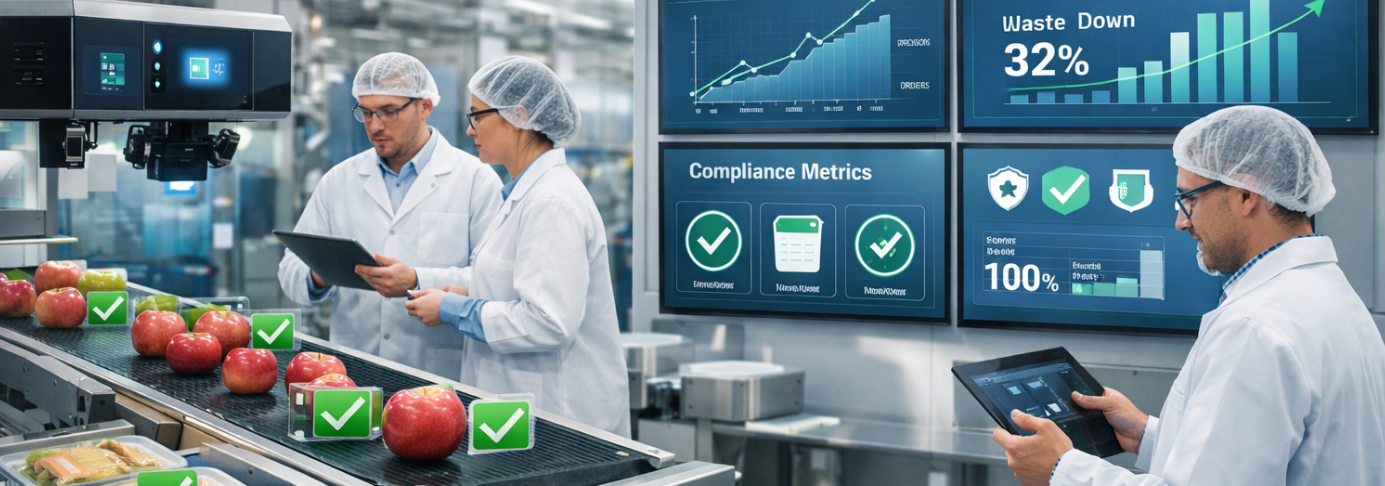
The food industry is facing a perfect storm. Labor shortages are getting worse, costs keep climbing, and customers want safer, higher-quality products. At the same time, new regulations are tightening the screws on traceability and compliance.
Here’s the thing: AI automation isn’t just some futuristic concept anymore. It’s solving real problems right now, and the numbers prove it. The AI market for food quality and safety alone is exploding from $2.7 billion in 2024 to a projected $13.7 billion by 2029. That’s a 50% growth rate every single year.
If you’re running a food business, you’re probably wondering whether AI makes sense for your operation, what it actually costs, and how to even get started. This guide cuts through the hype and gives you the straight answers.
Why Food Companies Are Turning to AI Right Now
The Labor Problem Isn’t Going Away
Finding reliable workers has become nearly impossible for many food manufacturers. When you do find people, training them takes time and money. Then they leave, and you start over.
AI systems don’t call in sick, don’t need benefits, and work 24/7. More importantly, they free up your existing staff to focus on tasks that actually need human judgment and expertise.
The Cost Squeeze Is Real
Everything costs more now. Energy prices, raw materials, transportation. You can’t control those external factors, but you can control how efficiently you operate. AI helps you waste less food, use less energy, and catch problems before they become expensive disasters.
The data backs this up. Companies using AI for demand forecasting are seeing forecast errors drop by 20-50%. That means less waste, fewer stockouts, and better cash flow.
Regulations Are Getting Stricter
The FDA’s FSMA Section 204 rule now requires 24-hour trace-back capability for high-risk foods. If there’s a contamination issue, you need to track it back to its source in one day. Try doing that with paper records or basic spreadsheets.
AI-powered traceability systems make this possible without drowning your team in paperwork.
What AI Actually Does in Food Operations
Catching Defects Before They Ship
Computer vision systems can inspect thousands of products per minute, spotting defects your human inspectors would miss. These aren’t just looking for obvious problems like foreign objects. They can detect subtle color variations, texture irregularities, and contamination that’s nearly invisible to the naked eye.
The key metric here is “false rejection rate.” That’s when the AI system incorrectly flags good product as bad. If this rate is too high, you’re throwing away perfectly good food and killing your margins. The best systems now have false rejection rates below 2%, meaning they’re more accurate than human inspectors while working 100 times faster.
Predicting What Customers Will Actually Buy
AI demand forecasting uses historical data, weather patterns, local events, and dozens of other factors to predict what you’ll need and when. One ice cream manufacturer using AI reduced their forecast error by 40%, which translated directly into less melted product, fewer emergency production runs, and happier retail partners.
This isn’t just about having enough product. It’s about having the right amount at the right time, which cuts both waste and lost sales.
Automating Delicate Tasks
Picking ripe strawberries or tomatoes without bruising them used to require human hands. New AI-powered robots can now identify ripeness through visual analysis and harvest delicate fruits with precision that matches or beats human pickers. They work through the night and don’t slow down when it gets hot.
For growers, this solves the seasonal labor crunch and reduces crop losses from delayed harvesting.
Making Vertical Farms Actually Profitable
Vertical farms have massive potential, but many struggle with profitability because energy costs eat up 30-40% of their operating budget. AI changes the economics by constantly adjusting lighting, HVAC, and nutrient delivery based on real-time plant needs.
Instead of running lights on fixed schedules, the AI learns which wavelengths and intensities work best for each crop at each growth stage. It cuts energy use without sacrificing yield, which is the difference between profit and loss for many indoor farms.
Meeting Compliance Requirements Without the Headache
The FSMA Section 204 Challenge
Starting in 2026, if you handle high-risk foods like leafy greens, fresh-cut fruit, or certain cheeses, you must be able to trace them back through your entire supply chain within 24 hours. The list of required data points is extensive: lot codes, harvest dates, supplier information, processing details, shipping records.
Manual systems just can’t handle this volume and complexity reliably.
How AI-Powered Traceability Works
Modern traceability systems use AI to automatically capture and link data across your entire operation. When raw materials arrive, the system logs supplier info, batch numbers, and quality specs. As products move through processing, it tracks transformations and mixing. When products ship, it connects everything to customer orders.
If there’s a recall, you can identify affected products and their locations in minutes instead of days. This limits your liability, protects your brand, and keeps you compliant.
The Real Implementation Questions
What Does This Actually Cost?
Here’s what nobody wants to tell you upfront: it depends on your operation size and needs. But let’s get specific about ranges.
A basic computer vision inspection system for a mid-size production line typically runs $50,000-150,000 for equipment and setup. Add another $10,000-30,000 per year for software licenses and support.
AI demand forecasting software starts around $15,000-40,000 annually for smaller operations, scaling up based on the complexity of your product mix and distribution network.
For a comprehensive traceability system meeting FSMA requirements, expect $30,000-100,000 for initial setup plus $500-2,000 monthly for cloud hosting and updates.
These aren’t small numbers, but compare them to the cost of a major recall (average of $10 million), persistent labor shortages, or chronic waste problems.
Calculating Your ROI
Start with your biggest pain points and quantify them. Are you losing $200,000 a year to food waste? Spending $150,000 on overtime trying to cover labor gaps? Facing potential fines for compliance issues?
A solid ROI framework looks at both hard savings (reduced waste, lower labor costs, fewer recalls) and softer benefits (better customer satisfaction, improved worker safety, competitive advantage).
Most food manufacturers see payback periods of 18-36 months for quality control and supply chain AI systems. Vertical farming automation often pays back faster because energy savings are immediate and substantial.
A Step-by-Step Implementation Guide for Smaller Operations
Step 1: Identify Your Biggest Problem
Don’t try to automate everything at once. Pick the area causing the most pain or the biggest financial drain. Maybe it’s quality control, maybe it’s demand forecasting, maybe it’s traceability.
Step 2: Document Your Current Process
Write down exactly how things work now, including all the steps, who does what, and where problems typically happen. This becomes your baseline for measuring improvement.
Step 3: Research Vendors Who Work with Companies Your Size
Most case studies feature giants like Nestlé and Unilever. That’s not helpful if you’re a regional producer. Look for vendors with experience in operations similar to yours. Ask for references you can actually call.
Step 4: Start with a Pilot Project
Don’t roll out company-wide. Pick one production line, one product category, or one warehouse. Prove it works, learn from mistakes, then expand.
Step 5: Train Your Team Early
The technology is only as good as the people using it. Start training before implementation, not after. Address fears about job security honestly. Most successful implementations redeploy workers to higher-value tasks rather than eliminating positions.
Step 6: Measure Everything
Track your key metrics before and after implementation. This proves ROI to leadership and helps you fine-tune the system for maximum benefit.
Comparing Vendors Without Getting Overwhelmed
Create a simple decision framework based on your must-haves:
- Integration: Does it work with your existing equipment and software?
- Support: Can you actually reach someone when there’s a problem?
- Scalability: Will it grow with your business?
- Track Record: Do they have successful implementations in your specific sector?
- Total Cost: What’s the real all-in price including training, support, and updates?
Get at least three vendors to submit detailed proposals based on the same requirements. Compare them side by side, not just on price but on overall fit and long-term viability.
Overcoming the Human Challenges
Your Team Will Resist Change
This is normal. People worry AI means layoffs. They’ve invested years learning the current system. Change is uncomfortable.
The most successful implementations happen when leadership communicates clearly and early about what’s changing and why. Be honest about how roles will evolve. When possible, involve frontline workers in the selection and implementation process. They often have insights that prevent expensive mistakes.
The Skills Gap Is Real But Solvable
Your current staff probably doesn’t know how to work with AI systems. That’s okay. Most vendors provide training, and the systems are designed to be user-friendly. You’re not turning line workers into data scientists.
Focus on hiring or developing one or two people who can serve as internal champions, understanding both the technology and your operations. They become the bridge between your team and the AI systems.
Frequently Asked Questions
How long does it take to implement AI automation in a food production facility?
For a focused application like quality inspection on a single line, expect 3-6 months from vendor selection to full operation. This includes equipment installation, software configuration, testing, and staff training. Larger implementations covering multiple areas or facilities can take 12-18 months. The key is starting with a pilot program that proves value quickly, then expanding gradually.
Can AI automation work for smaller food companies, or is it only for large corporations?
AI absolutely works for smaller operations, but you need to be strategic. Focus on one high-impact area rather than trying to automate everything. Cloud-based solutions with subscription pricing make entry costs much lower than they used to be. Many vendors now offer scaled-down versions specifically designed for regional producers and mid-size manufacturers. The key is finding solutions that match your scale and budget.
What happens if the AI system makes a mistake and lets contaminated product through?
AI systems are tools that assist human decision-making, not replacements for your entire quality control program. The best approach combines AI inspection with human oversight and traditional testing protocols. Most systems can be tuned to be extremely conservative, flagging anything questionable for human review. You also maintain your existing HACCP plans and critical control points. The AI makes your existing safety program stronger, not replace it entirely.
How do we justify the cost of AI automation when our margins are already tight?
Start by quantifying what problems are currently costing you. Calculate annual losses from food waste, labor inefficiencies, recalls, compliance issues, and missed sales due to stockouts. Then look at which AI application addresses your biggest cost drain. Often the ROI becomes obvious when you put real numbers to the problems. Also consider financing options and vendors who offer pilot programs with lower upfront costs. You don’t need to transform everything overnight.
Will implementing AI systems mean we have to lay off employees?
Most successful implementations redeploy workers rather than eliminate positions. Automation typically handles repetitive, physically demanding, or hazardous tasks, freeing people to focus on work requiring judgment, problem-solving, and customer interaction. In an industry facing massive labor shortages, AI helps you do more with your existing workforce. Be transparent with your team about how roles will evolve and invest in training to help them develop new skills.