
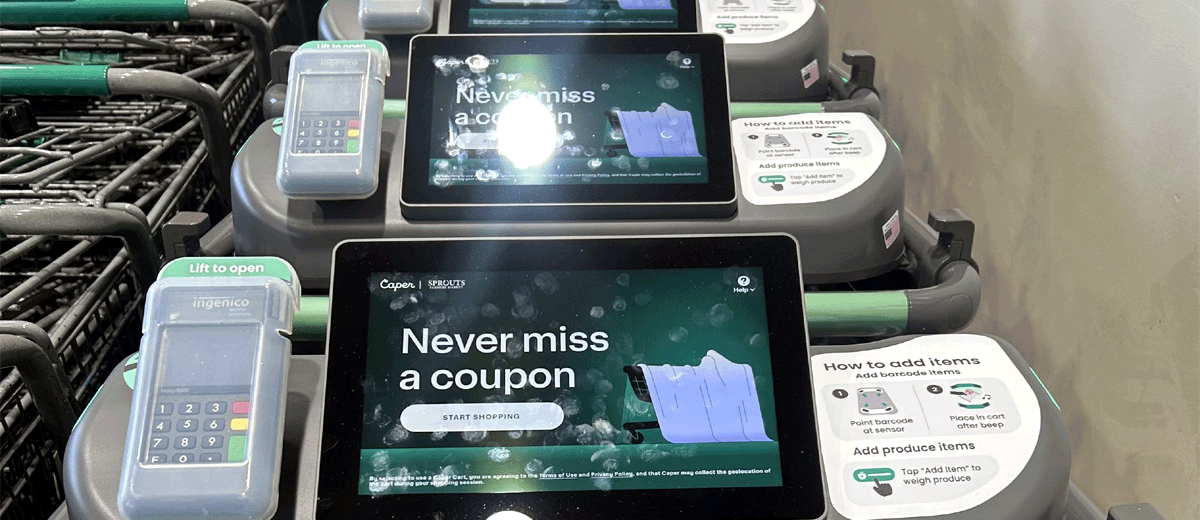
The shopping cart, long the most overlooked piece of equipment in the store, is becoming one of the most sophisticated. Driven by a category the industry has started calling “Physical AI,” retailers are rolling out connected carts like Instacart’s Caper Cart at speed. The pitch is straightforward: faster checkout, sharper promotions, fewer bottlenecks at the front end. The reality is more complicated, and grocery professionals would do well to understand both halves of the equation before signing on.
What These Carts Actually Are
Calling the Caper Cart a trolley undersells it. The hardware reads more like a tablet on wheels. Retailers including Kroger, ShopRite, Wegmans, Coles, Sobeys, and Morrisons have begun deploying versions of it, and the spec sheet is dense: an ABS/PC shell over an iron frame, an RK3399 processor (with an NVIDIA Jetson AI option for retailers who want more horsepower), a 10.1-inch touchscreen, three high-resolution cameras, GPS, certified weight scales, and onboard Wi-Fi.
The cameras identify products as shoppers drop them in. Weight sensors confirm what the cameras see. Location tracking runs continuously, store-wide. On the customer-facing side, that translates into aisle-aware promotions that fire based on where you’re standing, a running basket total for budget-minded shoppers, and loyalty integration that reportedly links up to 94 percent of trips to a known account.
Why Retailers Are Buying In
Eliminating the checkout line is the headline, but it’s not the whole business case. Aisle-aware prompts nudge impulse buys, the touchscreen becomes ad inventory, and the data flowing off the carts feeds everything from merchandising to robotics training. The numbers retailers are watching:
- $110 average basket size on cart-equipped trips, per Instacart
- 94% of trips reportedly linked to a known loyalty account
- 3 high-resolution cameras per cart, plus GPS and certified scales
- Del Monte and General Mills among the brands buying touchscreen ad placement
- 6+ named chains deploying versions: Kroger, ShopRite, Wegmans, Coles, Sobeys, Morrisons
Post-checkout incentives pull in-store customers toward the retailer’s digital storefront, knitting the two channels together. And the same data stream feeding merchandising decisions, out-of-stock prediction, and shrink mitigation is, further out, training the robotic systems meant to automate the store itself.
The Concerns Are Mounting
For every operator excited about basket lift, there’s a critic describing these devices as rolling sensor platforms. The capabilities run well past product scanning, and that’s where the friction lives.
The monitoring is constant. Carts log precise movement through the aisles, browsing behavior, and purchase patterns. Some observers argue the exterior cameras are doing double duty, capturing shopper body movement to train AI for future automation rather than to serve the person pushing the cart.
Biometrics raise the stakes further. Facial recognition is reportedly in play, and Instacart has declined to say how long recorded footage is retained. That matters more given documented accuracy gaps: independent testing has found facial recognition systems used in retail produce a 35 percent higher error rate for darker-skinned women than for lighter-skinned men.
Pricing is its own minefield. Research into so-called surveillance pricing suggests algorithms are testing dynamic rates, charging different shoppers different amounts for identical items, sometimes a 23 percent spread, keyed to perceived price sensitivity, location, or even the weather outside. For a family, the estimated cost runs as high as $1,200 a year.
Then there’s the nudge problem. Aisle-aware ads and personalized coupons are engineered to move product, and critics call the result algorithmic coercion, an environment built to manufacture impulse spending. Underneath all of it sits a labor question: the same data training shelf-stocking and order-picking robots is, by extension, training the systems that may eventually replace the workers generating it.
The figures critics keep pointing to:
- 35% higher facial-recognition error rate for darker-skinned women versus lighter-skinned men in retail testing
- 23% spread between what different shoppers can be charged for an identical item under dynamic pricing
- $1,200 estimated annual cost to a family exposed to surveillance pricing
- Undisclosed retention period for recorded camera footage, per Instacart
Where This Leaves the Industry
Smart carts deliver real operational value, and the adoption numbers suggest that value is being felt. But the technology arrives wrapped in unresolved questions about privacy, pricing fairness, and the durability of retail jobs. Shoppers have a stake in knowing what’s collected and how it’s used. Retailers carry the harder burden: being transparent about it, and getting out ahead of the bias and dynamic-pricing issues before regulators or customers force the conversation.