
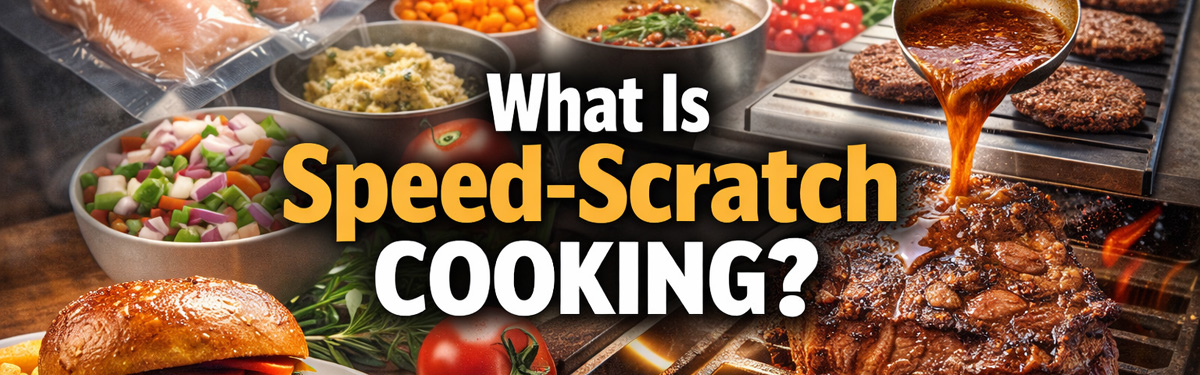
Defining Speed-Scratch Cooking
At its core, speed-scratch cooking integrates manufactured components—such as sous-vide proteins, knife-ready produce, concentrated stocks, reduction bases, compound butters, and specialty doughs—with fresh ingredients and chef-driven customization.
A typical application might involve sous-vide chicken as a protein base, pre-cut vegetables for speed and yield control, and a concentrated demi-glace as a flavor foundation, finished with fresh herbs, wine reductions, and signature seasoning.
This approach differs fundamentally from heat-and-serve operations. In speed-scratch kitchens, prepared components are treated as platforms rather than finished products. The
“scratch” element preserves menu identity while capturing significant efficiency advantages.
Who Is Using Speed-Scratch?
Adoption spans nearly every major foodservice segment, supported by extensive supplier infrastructure and operator education.
High-volume institutional operations such as education and healthcare use speed-scratch frameworks to maintain consistency across large serving volumes and variable staff skill levels. Casual dining and multi-unit concepts rely on prepared components to reduce labor dependency while maintaining accessible price points. Even elevated and fine-dining kitchens selectively integrate speed-scratch elements for foundational preparations, reserving in-house labor for signature dishes and finishing work.
Available components now span complete operational categories, including proteins, produce, foundational bases, and finishing elements, making speed-scratch adaptable to nearly any menu style or service model.
Why Speed-Scratch Has Become So Common
Labor Market Restructuring
Persistent shortages of skilled kitchen labor have forced operators to rethink traditional prep-heavy workflows. Speed-scratch compresses time-intensive tasks and reduces reliance on advanced technical skills for foundational preparation. Staff capacity can be redirected toward service quality, throughput, and revenue-generating activities.
Consistency and Quality Control
Prepared components function as standardization anchors, particularly in multi-unit or high-volume environments. Advanced manufacturing techniques such as precision sous-vide, blast chilling, and controlled-atmosphere packaging often deliver consistency and yield reliability that individual kitchens cannot easily replicate.
Financial Optimization
While prepared components typically carry higher unit costs than raw ingredients, total-cost analysis often favors speed-scratch. Labor savings, waste reduction, improved yields, simplified inventory, and menu flexibility frequently offset higher ingredient prices. Operators can introduce seasonal items or limited-time offerings without expanding inventory complexity or retraining staff.
How Operators Implement Speed-Scratch
- The market includes both premium culinary components and commodity products optimized for shelf stability and price. Operators define quality thresholds aligned with their brand positioning and source accordingly. Products designed to enhance flavor and texture preserve menu credibility; poorly matched components can undermine it.
- Speed-scratch works best when prepared components serve as customization platforms. A pre-reduced stock becomes the base for a signature sauce. A sous-vide protein is finished with searing, glazing, or proprietary seasoning. This model preserves differentiation while delivering efficiency gains.
- It doesn’t work for concepts built around hyper-local sourcing, farm-to-table narratives, or complete from-scratch preparation. You’ll see it used by operator focused on scale, reliability, speed.
- A hybrid method of speed-scratch cooking combined with high-quality prepared components with fresh finishing—is now a core operational strategy in modern foodservice. Its prevalence reflects rational responses to labor scarcity, rising costs, and increasing demands for consistency and value.
For most operators, the strategic question is no longer whether speed-scratch belongs in their kitchens, but how deliberately it should be applied to support brand identity, economics, and operational realities.